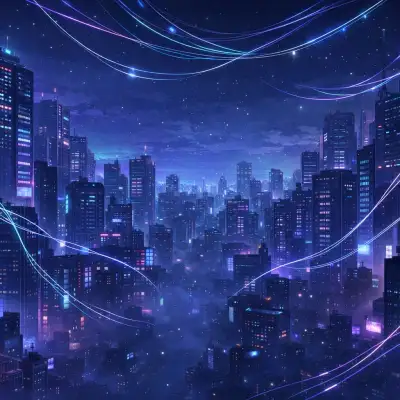



How to Optimize Wallpapers for Mobile and Desktop: Resolutions, Cropping & Icon-Safe Design

by Imaginawalls
January 26, 2026 — 4 Min readCreating beautiful AI images is only half the job. Turning those images into great wallpapers is something else entirely.
A wallpaper isn’t judged in isolation—it lives behind icons, widgets, clocks, and notifications. That’s why many visually impressive AI images fail as wallpapers: they’re too busy, badly cropped, or place important details exactly where app icons sit.
In this guide, I’ll show you how to optimize wallpapers for both desktop and mobile, using the same workflow I apply on ImaginaWalls: design for real screens first, then use AI to refine composition.
You’ll learn the exact resolutions to use, how to crop intelligently, and how to design “icon-safe” layouts that actually feel good in daily use.
Desktop vs Mobile: Two Completely Different Design Problems
The biggest mistake beginners make is assuming one image works everywhere.
Desktop and mobile wallpapers behave differently:
- Desktop: wide, landscape, icons usually on the left or right
- Mobile: vertical, centered, with clock and widgets at the top
If you ignore this, your subject gets covered—or worse, chopped in half.
Recommended Resolutions (Practical Standards)
These are the sizes I use as a baseline:
- Desktop (16:9): 3840 × 2160 (4K)
- Desktop (Ultrawide): 5120 × 2880
- Mobile (9:16): 2160 × 3840
- Square previews: 1080 × 1080
Always generate or upscale at higher resolution, then downscale if needed. This preserves sharpness.
The “Icon-Safe Zone” Concept
Professional wallpaper designers always reserve empty areas for UI elements.
I call this the icon-safe zone:
- On desktop: usually left or right third of the image
- On mobile: upper third for clock + widgets, lower half for icons
Your subject should never compete with these areas.
In prompts, I explicitly request this:
balanced composition with ample negative space on the left for icons
or
centered subject with clean upper area for clock and widgets
Using AI to Design for Screens (My Workflow)
I don’t generate random images and crop later. Instead, I design for format from the start.
Here’s the process:
- Step 1: Use ChatGPT to generate two prompts: desktop + mobile
- Step 2: Generate artistic versions in MidJourney
- Step 3: Use DALL·E to create cleaner layout variants
- Step 4: Export both formats separately
This avoids awkward crops and preserves composition.
Prompt Templates (Copy & Paste)
Desktop Wallpaper Template:
[subject], wide shot, rule of thirds composition, negative space on right for icons, cinematic lighting, soft haze, crisp edges, high clarity, 4K wallpaper, no text, no watermark, no logo
Mobile Wallpaper Template:
[subject], centered composition, clean upper area for clock, minimal background, soft lighting, subtle texture, icon-friendly, vertical 9:16, 4K mobile wallpaper, no text, no watermark, no logo
Smart Cropping: When You Already Have a Horizontal Image
Sometimes you already have a desktop wallpaper and want a mobile version.
Don’t blindly crop the center.
Instead:
- Identify the main subject
- Shift it slightly downward
- Preserve empty space at the top
- Remove side clutter
DALL·E is excellent for this—simply upload the image and request a vertical version with centered subject and clean upper space.
Visual Noise: The Silent Wallpaper Killer
Many AI wallpapers fail because they’re too detailed.
On real phones, micro-details become visual chaos.
That’s why I deliberately ask for:
- Simple backgrounds
- Soft gradients
- Reduced micro-texture
- Clear silhouettes
Less detail = better usability.
Common Mistakes to Avoid
- Putting faces under clock widgets
- Placing bright highlights behind icons
- Overusing sharp contrast everywhere
- Forgetting vertical versions
- Leaving random artifacts
Export Settings (Final Polish)
Before publishing:
- Export in WebP or optimized JPEG
- Keep file size under ~2MB if possible
- Sharpen lightly after resizing
- Preview on real devices
This final step makes a big difference in perceived quality.
The ImaginaWalls Philosophy
On ImaginaWalls, every wallpaper is designed to feel calm behind daily life.
That means:
- Composition first
- Usability over spectacle
- Clean design over excessive detail
AI helps generate images—but intention turns them into wallpapers.
Final Thoughts
Great wallpapers respect the screen they live on.
When you design with icon-safe zones, proper resolutions, and real-device layouts in mind, your wallpapers stop feeling experimental—and start feeling professional.
Next post teaser: In the next article, I’ll break down real engagement examples and show how AI-generated wallpapers increase time-on-site, downloads, and user retention.